In August 1972, Idi Amin gave the Ugandan Asians 90 days to leave the country. Tens of thousands left with little more than a suitcase. Within a few years, Uganda’s factories stood still and its shops were empty. The expulsion is well known. What it cost the economy, and how much of the collapse it really explains, is told less often.
A community built by a railway
The story begins with the Uganda Railway. Between 1896 and 1901, Britain recruited around 32,000 labourers in India to lay a line of roughly 600 miles from Mombasa on the Kenyan coast towards Lake Victoria. The work was brutal. According to Britain’s National Railway Museum, 2,493 workers died in East Africa and more than 6,000 were seriously injured.
Most of the labourers went home when their contracts ended, but about 6,700 stayed. The colonial government would not sell them land, so they became shopkeepers, artisans, traders and clerks. More South Asians followed over the next decades. In Buganda, the 1900 agreement with the British had made land the surest source of wealth for the local elite, so trade was left to the newcomers. Over time, families of Indian origin came to run much of the retail and wholesale trade, as well as cotton ginning and the processing of coffee and sugar.
The economist Vali Jamal, who was in Uganda in 1972 collecting data for a Stanford dissertation, summed up the arrangement in three lines. Africans were the farmers. Asians processed the crops and ran the shops. Europeans handled the exports. Not every Asian family was wealthy, and many lived modestly. But a small share of the population earned a large share of the national income, and everyone could see it.
Strangers on paper before Amin
The road to 1972 started years before Amin took power. At independence in 1962, the constitution gave automatic citizenship only to people with a parent and a grandparent born in Uganda. The scholar Mahmood Mamdani, who lived through the period, has estimated that no more than one in ten Ugandan Asians would have qualified. Many chose British passports instead, expecting that Britain would take them in if they ever had to leave.
Britain then narrowed that door. Its Commonwealth Immigrants Acts of 1962 and 1968 brought in strict controls, and the 1968 act restricted entry for passport holders without a parent or grandparent born in the United Kingdom. A British passport no longer guaranteed a right to live in Britain. The 1969 census counted about 70,000 people of Indian or Pakistani descent in Uganda. More than half had been born there, yet most were still officially foreigners. By Mamdani’s account, some 20,000 held Ugandan citizenship, and roughly as many applications lay unprocessed.
President Milton Obote’s government tightened the pressure. A 1969 law on trade licences and a 1970 immigration act were aimed at Asians without citizenship. In January 1969, according to the Daily Monitor, Obote told reporters in London that around 40,000 people with British or Indian passports could be expelled. In May 1970 he announced that the state would take a 60 per cent stake in 84 companies. A CIA memo from February 1971 noted that most of the local firms among them were owned by Asians.
Ninety days from a dream
Amin seized power in January 1971 while Obote was abroad, and at first he looked like a friend of business. He promised to restore confidence in the economy and began to reverse the nationalisations. Many Asian traders reportedly greeted the coup with relief. You can read more about his rise in our story on how the Kagera land grab ended Idi Amin.
Within a year, the mood had changed. Amin asked Israel and Britain for weapons and loans, and both turned him down. In February 1972 he flew to Libya, where Muammar Gaddafi agreed to help on condition that he broke with Israel. Weeks later the Israeli advisers were ordered out. On 4 August 1972, in a speech to soldiers in the eastern town of Tororo, Amin said that God had spoken to him in a dream and that the Asians must go. No source proves a link between these events, but the order of the dates is clear.
The first order covered Asians who were British subjects. Within days it was widened to citizens of India, Pakistan and Bangladesh, and by late August almost no one was exempt, including many who held Ugandan passports. The deadline was midnight on 8 November. Amin accused the Asians of sabotaging the economy and called them bloodsuckers. Those still in the country after the deadline, he warned, could end up in military camps.
Leaving with fifty pounds
Estimates of how many people were affected range from about 50,000 to 80,000, and the exact number is still disputed. Families were allowed to leave with about 50 pounds. Witnesses described soldiers at roadblocks on the way to Entebbe airport taking watches, jewellery and cash. One retired clerk from Kampala told British reporters that his gold watch had been pulled off his wrist on the road.
Under international pressure, Edward Heath’s government accepted responsibility for those who held British passports. The first charter flight landed at Stansted on 18 September 1972 with 193 passengers on board, and hundreds more flights followed. Not everyone in Britain was welcoming. The city council of Leicester paid for an advertisement in the Uganda Argus telling Asians not to come.
Around 27,000 to 28,500 settled in Britain. Nearly 7,000 went to Canada, about 4,500 to India, and smaller groups ended up in other countries, among them the Netherlands. About 10,000 were left stateless. Within three months, a whole layer of Ugandan society had gone.
Shops handed out by decree
What happened to the businesses is the heart of the story. A confidential World Bank report from 1979 describes it in a single sentence: the Asians were expelled, and their businesses were allocated to government nominees. A 1973 decree placed the abandoned property under a new body, the Departed Asians Property Custodian Board. Compensation was minimal. Land and buildings more than ten years old were not compensated at all.
The new owners often had no training for the work. The World Bank found that there was no plan to build up their skills, and that Uganda was losing trained people at the same time. What the businesses did get was credit. Bank lending more than tripled between 1971 and 1978, often under pressure to lend to firms that could not pay it back. Price controls came and went, and goods moved onto the black market.
The Ugandan historian A. B. Kasozi called the Asian community the grease of the upper economy. Their departure took away a large part of the urban tax base, a pool of skilled workers and the trade links that kept factories supplied. A study of Busoga, then Uganda’s industrial heartland, found the same pattern of scarce goods, closed factories, lost jobs and a growing informal economy. It also found that some local people did benefit from taking over Asian businesses.
What the numbers show
In 1970, Uganda had one of the highest incomes per person in eastern Africa. From the early 1970s to 1978, according to the World Bank, real output fell by about one per cent a year while the population grew by more than three per cent. Income per person dropped by roughly a quarter. Export crops, manufacturing, mining and construction were hit hardest. Only subsistence farming grew, as farmers turned from cash crops to food.
The production figures are stark. Coffee fell from 251,000 tonnes at its 1969 peak to about 120,000 tonnes by 1978. Cement output fell from 171,000 tonnes a year to 50,000, and soap from 11,000 tonnes to 1,000. Sugar fell furthest, from 144,000 tonnes in the early 1970s to about 8,000 tonnes by the end of the decade. The Madhvani family’s estate at Kakira, one of the largest sugar producers, had been taken over in 1972, and was in ruins when the family returned.
Spending did not fall with output. Government expenditure kept rising while revenue lagged far behind, and the gap was covered by printing money. The money supply grew almost sixfold between 1971 and 1978, and official prices rose by about a quarter every year. Ugandans had a word for what followed: magendo, the black market of smuggling and official corruption. By 1979, the World Bank wrote, almost everyone had to take part in it to survive.
Only half the explanation
The usual telling is simple. Amin threw out the businessmen, and the shops ran dry. The World Bank put it differently. It said the decline was largely the result of government policies, and the expulsion was only one of them. Obote’s takeovers in 1970, their extension under Amin’s economic war, the expulsion in 1972 and new seizures of foreign firms in 1975 were four separate shocks.
Other blows followed. Deficit spending fed inflation, and the East African Community, which tied Uganda’s trade to Kenya and Tanzania, collapsed in 1977. The war with Tanzania in 1978 and 1979 made a bad situation far worse. A coffee price boom in 1976 and 1977 briefly hid the damage, but it did not stop the slide. No study has cleanly separated the effect of the expulsion from the rest, and perhaps none can. The same government chose who received the businesses, how they were financed and what they could charge.
What the sources agree on is the sequence. The expulsion removed a connected layer of the economy all at once, with nothing ready to replace it. Credit, price controls and inflation then made each problem worse. Near the end of its report, the World Bank noted that Uganda still had skilled and trained people at home and abroad, though many had lost heart. What the country had lost was the system that held them together.
Ninety days to come back
Amin was driven out in April 1979 and died in exile in Saudi Arabia. In 1982, Uganda’s parliament passed the Expropriated Properties Act, which allowed the former owners to reclaim what had been taken. They were given 90 days to apply. Few came. The Madhvani family returned in 1985 and began to rebuild the Kakira estate.
In 1992, under pressure from the World Bank and Western donors, President Yoweri Museveni invited the expelled Asians home and moved to hand back 7,470 properties, much of downtown Kampala, worth about a billion dollars. The Christian Science Monitor reported that only about 700 people had accepted the invitation by then. On the 50th anniversary in 2022, Museveni called the expulsion shameful and regrettable.
The custodian board created in 1973 still exists, and Ugandan lawmakers have complained that it still has no complete register of the properties it manages. Sugar, at least, has recovered. Uganda now produces enough for its own market and sells the surplus to Kenya, with Kakira among the leading producers. In 1972, the Asians were given 90 days to leave, and almost everyone went. Ten years later they were given 90 days to come back, and most never did.
This article draws on the documentary by the YouTube channel Measured Record.
Photo: Asians expelled from Uganda waiting at Schiphol airport, Amsterdam, 30 November 1972. Bert Verhoeff/Anefo, Nationaal Archief, CC0.
Relaterte innlegg
 How the Kagera land grab ended Idi Amin
In November 1978, Idi Amin posed for photographers in a field in northwest Tanzania. His…
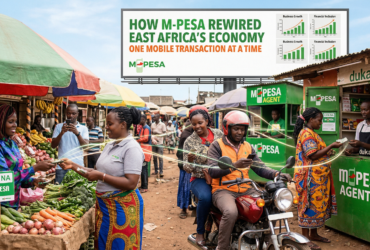 Hvordan M-Pesa omformet Øst-Afrikas økonomi én mobiltransaksjon av gangen
I 2007 ble et beskjeden SMS-basert betalingssystem lansert i Kenya med et enkelt løfte: la folk sende penger ved å bruke ikke mer enn en enkel mobiltelefon. Få kunne ha forutsett at M-Pesa ville gå…
 Øst-Afrika reise: Kenya, Tanzania, Uganda og Rwanda
Planlegg reisen din til Øst-Afrika med denne guiden til safari, gorillatrekking og skjulte perler i Kenya, Tanzania, Uganda og Rwanda.