The Kenyatta International Congress Centre (KICC)
When Kenya gained independence in 1963, the young nation faced a defining question: What would its future look like?
Part of the answer stands boldly today in the heart of Nairobi — the Kenyatta International Convention Centre (KICC). More than a building, it was imagined as a symbol of unity, progress and Kenya’s entry into the global arena.
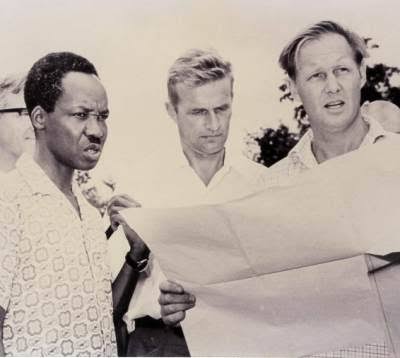
What many don’t know is that this landmark was born from an extraordinary cross-cultural partnership between a Norwegian architect, Karl Henrik Nøstvik and Kenya’s first Chief Architect, David Mutiso. Together, they created a structure that blended modernist ambition with Kenyan identity, transforming Nairobi’s skyline and cementing Kenya’s place on the world stage.
A Vision Born in a New Kenya (1967)
In the late 1960s, the newly independent Kenyan government sought to define a national identity rooted in pride, progress and global presence. Nairobi needed a venue where leaders could gather, a place that embodied diplomatic ambition and cultural confidence.
President Jomo Kenyatta envisioned:
- A world-class conference facility
- A national landmark
- A symbol of East Africa’s modern future
To bring this vision to life, two architectural minds converged:
- Karl Henrik Nøstvik (Norway) — trained in Scandinavian modernism, introduced bold geometric forms and international standards.
- David Mutiso (Kenya) — rooted the structure in Kenyan culture, symbolism, and climate.
Their union was more than professional — it was symbolic.
A young Kenya collaborating with global expertise to shape its identity and future.
Designing KICC: Where Modernism Meets Kenyan Soul
Construction began in 1967, and what emerged was unlike anything Africa had seen before.
- The Cylindrical Tower: Rising to 105 meters with 32 floors, it represents strength, continuity, and unity.
Fun fact: for years, it was Nairobi’s tallest building.
- African Motifs Modernized: The Amphitheatre echoed traditional communal spaces, interiors celebrated local craftsmanship, and warm earth tones mirrored East African landscapes.
- Built for Diplomacy: With simultaneous translation systems, breakout rooms, and even a rooftop helipad — futuristic for its time — KICC boldly declared: “We belong on the global stage.”
Fun Facts That Inspire Pride
- On Kenyan Currency: KICC is featured on the 100-shilling note, making it a daily symbol of national pride.
- Global Coordinates: Its exact location — 1°17′19″S, 36°49′23″E — places it at the very heart of Nairobi.• Helipad Fame: The rooftop helipad is not just functional; it’s one of Nairobi’s most photographed spots, offering panoramic views that have become a rite of passage for visitors.
- Cultural Stage: Beyond politics, KICC hosts festivals, exhibitions, and performances, showcasing Kenya’s vibrant arts and culture.
- Norwegian Kenyan Legacy: Few know that this collaboration was one of the earliest architectural unions between Africa and Scandinavia — a quiet but powerful symbol of solidarity across continents.
Leadership, Politics & Collaboration
KICC emerged from a rare blend of vision, influence, and creativity:
- President Jomo Kenyatta drove the project as a defining symbol of a young nation.
- Minister Mbiyu Koinange oversaw its progress and ensured its completion.
- Mutiso and Nøstvik fused international modernism with Kenyan cultural depth.
It was this collective alignment — political, cultural, and architectural — that transformed KICC from an idea into an enduring icon.
Opening Day: 11 September 1973
President Kenyatta officially inaugurated KICC in 1973 and by 1974 the project was complete.
At the time, it was:
- Nairobi’s tallest building
- Africa’s most advanced conference facility
- A national treasure anchoring the Central Business DistrictLegacy: Why KICC Still Matters Today
- Africa’s Diplomatic Stage: Hosting AU summits, global conferences and cultural festivals.
- National Symbol: Appearing on currency, postcards and branding.
- Urban Landmark: Its rooftop remains a magnet for tourists, photographers and content creators.
A Cross-Cultural Masterpiece
The partnership between Karl Henrik Nøstvik and David Mutiso remains one of the most celebrated architectural unions in Kenyan history. Their work proved that:
- International and local visionaries can build greatness together
- Architecture can bridge cultures
- Buildings can embody the spirit of a nation
KICC is not just concrete and glass — it is a story of collaboration, ambition, identity and legacy. A landmark built by two men from different worlds, unified by one vision: to give Kenya a place to stand tall.
Related Posts
 Riding the rails: Kenya’s SGR and the future of east
Dawn at Nairobi Terminus At 6:00 a.m., the cavernous hall of Nairobi Terminus hums with…
 The Story of Kenya’s Matatu Culture: Icons, Chaos, and Art on Wheels
If Nairobi had an official soundtrack, it would be the bass-heavy rumble of matatus —…
 Kenya’s History – Timeline
A chronology of important events in the area we know today as Kenya: Approximately 3.3…
 English (UK)
  Svenska
  Dansk
Dansk  Kiswahili
  Norsk bokmål